

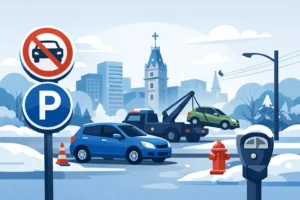
A lot of parking tickets in Quebec happen for the same reason – the driver thought a spot looked fine. Then a hidden sign, a time restriction, or a winter rule turned a quick stop into an expensive mistake. If you are learning the parking rules for Quebec drivers, the good news is that most problems are avoidable once you know what to watch for.
For new drivers, newcomers, and anyone preparing for the SAAQ road test, parking is not just about fitting the car into a space. It is about reading the environment, understanding local restrictions, and making safe decisions under pressure. In cities like Montreal, that matters every day.
Why parking rules for Quebec drivers can feel confusing
Quebec parking rules are not difficult because the basic idea is hard. They feel difficult because several layers can apply at once. A posted sign may limit parking by hour, by day, by season, or by permit type. Street cleaning, snow removal, bus zones, loading areas, and school zones can add restrictions that are easy to miss if you are rushed.
This is especially true for beginners and immigrants who may already be adapting to Quebec road signs and local driving habits. A legal parking spot at 2 p.m. may be illegal at 5 p.m. A street that seems open in summer may have overnight winter restrictions. That is why experienced instructors teach parking as a decision-making skill, not just a vehicle control skill.
Start with the signs, not the empty space
Before you think about angle, distance, or backing in, check the sign. An open curb does not automatically mean you can park there. In Quebec, posted signs control the space, and they often include time windows, arrows showing the affected zone, or specific conditions such as resident permits or commercial vehicles only.
If more than one sign is posted, read all of them together. This is where many drivers get caught. One sign may allow parking for a certain period, while another may block it during rush hour or on cleaning days. If the instructions seem to conflict, assume the more restrictive rule applies until you are sure.
Pay attention to arrows. A sign may apply only to the section of curb before it, after it, or both. On busy streets, one pole can control multiple spaces with different rules in each direction.
Common places where you usually cannot park
Some restrictions are consistent enough that every driver should know them without hesitation. You generally cannot park where your vehicle creates a safety risk, blocks visibility, or interferes with traffic flow. That includes areas close to intersections, fire hydrants, crosswalks, bus stops, driveways, and entrances.
You also need to stay out of spaces reserved for emergency vehicles, accessible parking without the required permit, and clearly marked no-parking or no-stopping zones. The difference between no parking and no stopping matters. In a no-parking zone, stopping briefly to drop off or pick up a passenger may sometimes be allowed depending on the signage and local rule. In a no-stopping zone, even that is not allowed.
Curb markings can also matter. If a curb is painted or specially marked, treat it as a warning to check for restrictions nearby. Never rely on curb space alone when signs are present.
Parking near intersections, crossings, and hydrants
This is one of the most tested and most ticketed areas. Quebec drivers are expected to leave enough space near intersections and crossings so everyone can see and move safely. If you park too close to a corner, drivers turning into the street may not see pedestrians or oncoming traffic clearly.
The same safety logic applies to fire hydrants. Even if you are stopping for only a minute, blocking access can create a serious problem. During lessons, we often remind students that parking laws are built around visibility and access. When a rule seems strict, there is usually a safety reason behind it.
If you are ever unsure whether you are too close to a protected area, do not guess. Move the car and find a clearer space. That small decision is cheaper than a ticket and much safer than creating a hazard.
Winter parking changes everything
In Quebec, winter parking rules deserve special attention. Snow removal operations can create temporary bans, overnight restrictions, or alternating side rules that do not exist during other seasons. A spot that was legal yesterday may be restricted tonight because plows need access.
This is where newcomers often get surprised. In many neighborhoods, temporary notices or municipal directives can affect parking quickly during snowfall. Fines and towing are common because snow clearing depends on open streets. If your vehicle blocks the operation, the issue is no longer just about your convenience.
Make it a habit to check winter parking notices during snowy periods, especially if you park on the street overnight. If the weather changes, your parking plan should change too.
Time limits, meters, and permit zones
Many legal parking spaces are only legal for a specific amount of time. One hour, two hours, or limited daytime access are common examples. Drivers sometimes assume payment at a meter means they can stay as long as they want. Usually, it only means you have paid for the allowed period. If the sign sets a maximum stay, paying more does not always override that limit.
Residential permit zones are another common issue, especially in Montreal. Some streets are reserved for local permit holders during certain hours. Visitors may be allowed outside those hours, or they may be restricted entirely depending on the block. Always verify the sign before leaving the car.
For students preparing for the road test, this matters because examiners want to see that you notice parking controls before choosing a space. Safe parking begins with legal parking.
How to park legally and safely on the street
Good parking technique supports legal parking, but it does not replace it. Once you have confirmed the space is allowed, park close enough to the curb, straighten the vehicle when possible, and avoid taking more room than necessary. Your tires should not be left at an angle that pushes the car outward into traffic unless the slope and local rule call for wheel positioning.
On a hill, wheel direction matters. New drivers often focus only on the brake, but proper wheel placement adds protection if the vehicle rolls. Uphill and downhill parking are basic safety skills that can also appear during driver training and testing.
When parallel parking, do not force your way into a space that is too small. If you need repeated corrections because the spot is unrealistic, choose another one. A calm decision is better than a rushed maneuver that leaves the car too far from the curb or too close to another vehicle.
Parking mistakes that lead to tickets and towing
Most costly mistakes are not dramatic. They are small assumptions. Drivers stop in front of a driveway for a minute, leave the car in a snow route overnight, ignore a weekday time limit, or miss the arrow on a sign. The vehicle looks parked properly, but it is still parked illegally.
Another common mistake is treating hazard lights as permission. They are not. Turning on your flashers does not cancel a no-stopping zone, bus stop restriction, or fire lane rule. If the place is restricted, the lights will not protect you from a fine or tow.
Double parking is another risk, particularly in busy urban areas. Even a short stop can block traffic, bike movement, or emergency access. If you need to wait, find a legal place to do it.
What new drivers should practice before the road test
For beginners, parking confidence comes from repetition. Practice reading signs before you park, not after. As you drive, ask yourself whether a spot is legal before committing to it. That habit builds the awareness examiners want to see.
You should also practice parallel parking, parking on a hill, and choosing spaces without rushing. Instructors often see the same pattern: students can control the car, but they hesitate when signs, traffic, and pressure all happen at once. Structured practice helps connect the rules to real situations.
At Ecole Unity, that confidence-building approach matters because passing the test is only part of the goal. You also want to feel ready to park independently in the neighborhoods, side streets, and busy areas you will actually use.
When the safest choice is to keep driving
Not every open space is worth taking. If a sign is hard to read, snow covers the curb, traffic is building behind you, or you are unsure about the restriction, keep driving and find a clearer option. That is not hesitation. That is judgment.
Quebec parking rules reward careful drivers. The more you slow down, read the signs fully, and think about visibility, access, and timing, the fewer unpleasant surprises you will have. A smart parking decision starts before the wheels stop moving, and that habit will serve you long after the road test is over.