

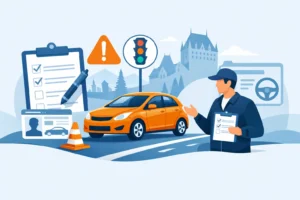
You can drive well in practice and still lose marks on test day for something small – not checking a blind spot, rolling too far at a stop, or showing up without the right documents. That is why understanding Quebec road test requirements matters as much as practicing your parking and lane changes. If you know what the examiner expects before you arrive, the road test feels less like a surprise and more like the last step in a process you are ready to complete.
What the Quebec road test is really checking
The SAAQ road test is not designed to catch you on tricks. It is meant to confirm that you can drive safely, follow Quebec traffic laws, and make sound decisions in normal road conditions. That includes basic vehicle control, but it also includes judgment, observation, and calm behavior under pressure.
For many learners, especially first-time drivers and newcomers, this distinction matters. You do not need to drive like a taxi driver with ten years of experience. You do need to show that you are alert, predictable, and safe. Examiners look closely at how you scan intersections, how you manage speed, how you respond to signs and signals, and whether you keep proper space around your vehicle.
Quebec road test requirements before you book
Before you can take the road test, you must meet the licensing conditions set by Quebec. The exact path can vary a little depending on your age, previous driving history, and whether you are transferring experience from another country, but most first-time drivers in Quebec need to complete the mandatory process tied to a recognized driving course.
In general, that means you must have held the required class of learner’s license for the minimum period and completed the necessary stages of driver education before becoming eligible for the practical exam. If you are a teenager starting from zero, the timeline is different from an adult with recognized prior experience. If you are a newcomer, what counts for you may depend on the jurisdiction your previous license came from and whether an exchange or additional testing applies.
This is where many people get confused. The road test itself is just one appointment, but your eligibility is tied to the larger licensing path. If you are not sure where you stand, it is worth confirming your status well before your preferred test date.
What to bring on test day
One of the most overlooked Quebec road test requirements is simply arriving with the right items. If your paperwork is missing or expired, your test may not go ahead.
You should expect to bring your valid learner’s license or the license document that applies to your testing stage, along with any appointment confirmation or identification requested for your case. If you are using a rented vehicle for the exam, the vehicle documents must also be in order. That usually includes valid registration and proof that the vehicle is properly insured.
If you wear glasses or contact lenses and your license requires corrective lenses, wear them. If the vehicle has any warning lights on, obvious safety issues, or paperwork problems, the examiner may refuse to use it for the test. Many learners practice for weeks and then run into trouble because of an avoidable document or vehicle issue.
Vehicle rules you cannot ignore
The car you bring is part of the test. It must be safe, roadworthy, and legal to operate. That sounds obvious, but this is one of the most practical Quebec road test requirements to prepare for in advance.
The examiner will expect the vehicle to be in good working condition. The brake lights, turn signals, horn, windshield, mirrors, and seat belts should all function properly. Tires need to be in acceptable condition, and the car should be generally clean and free of anything that blocks visibility or interferes with the controls.
There is also a confidence factor here. When you take the test in a vehicle you already know, you remove one major source of stress. If you borrow a family car that feels different from what you practiced in, even routine maneuvers can feel harder. That is one reason many learners prefer a road-test vehicle they have already used in lessons.
What happens during the road test
The practical exam usually begins with a few initial checks and instructions. The examiner may ask you to identify or use basic controls such as turn signals, hazard lights, or defrosters. From there, you will drive on public roads and be assessed in real traffic.
You may be asked to perform routine maneuvers such as starting and stopping smoothly, turning at intersections, changing lanes, backing up, parking, and handling traffic signs and signals correctly. The route can include residential streets, busier roads, and situations that test how well you observe pedestrians, cyclists, and other vehicles.
What matters most is not performing every action perfectly in a robotic way. Examiners want to see safe habits. That means checking mirrors regularly, doing clear shoulder checks, respecting speed limits, yielding properly, and adapting to road conditions. If visibility is poor or the street is crowded, your decisions should reflect that.
Common reasons people lose points
A lot of test-day mistakes come from nerves, not lack of knowledge. Still, certain patterns come up again and again.
Observation errors are one of the biggest problems. Learners often check mirrors but forget a full blind-spot check before changing lanes or pulling away from the curb. Others stop at the sign but fail to scan the intersection thoroughly before moving.
Speed management is another issue. Some candidates drive too fast because they are anxious to keep up with traffic. Others drive too slowly and create uncertainty. The goal is controlled, legal, steady driving that matches the conditions.
Positioning also matters. Wide turns, drifting within the lane, stopping too far into a crosswalk, and parking without enough control can all cost points. Then there are the small but costly habits – forgetting to signal, not coming to a complete stop, or hesitating so long that you disrupt traffic.
How to prepare without overcomplicating it
The best preparation is focused practice, not random driving. Start by making sure you are comfortable with the exact skills the examiner is likely to assess. If parallel parking still feels shaky, work on that. If lane changes in city traffic make you tense, practice them until the process feels automatic.
It also helps to rehearse the test mindset. That means driving with commentary in your own head: mirror, signal, blind spot, move. Scan the intersection. Check the speed. Look for pedestrians. The more consistent your routine becomes, the less likely stress will knock you off track.
If you are a newcomer to Quebec, spend extra time on local rules and road habits. Even experienced drivers can struggle if they rely on habits from another country. Sign interpretation, right-of-way expectations, school zones, and city driving patterns can all feel different.
A short round of targeted lessons before the exam can make a real difference, especially if you want feedback on test-level driving instead of casual everyday driving. At Ecole Unity, that support is often most helpful for students who are close to ready but need a final layer of structure and confidence.
The trade-off between waiting longer and testing sooner
Some learners postpone the exam until they feel one hundred percent ready. Others book quickly because they do not want to lose momentum. There is no single perfect strategy.
Waiting a little longer can help if you still make repeated safety errors or have not practiced enough in varied traffic conditions. But waiting too long can also increase anxiety, especially if you stop driving regularly. In many cases, the better approach is to book when your core skills are consistent and then use the time before the appointment for focused practice.
If you are asking yourself whether you are ready, be honest about the difference between nervousness and lack of skill. Feeling nervous is normal. Not being able to perform basic checks and maneuvers consistently is a different issue.
A simple test-day plan that helps
Try not to make test day harder than it needs to be. Get enough sleep, arrive early, and use a car you are comfortable driving. Give yourself time to settle in so you are not walking into the appointment already stressed.
Right before the test, do not cram everything at once. A short warm-up drive can help more than an hour of last-minute corrections. During the exam, listen carefully to instructions and ask for clarification if you truly did not hear something. If you make a small mistake, keep driving safely. Many candidates spiral after one imperfect moment and then create bigger problems.
If you do not pass the first time
Failing a road test feels discouraging, but it does not mean you are a bad driver or that you cannot succeed soon. Usually, it means there are a few habits that need correction under exam conditions.
The useful question is not just whether you passed or failed. It is why. If your result points to observation, lane positioning, or decision-making, those are coachable skills. A focused review is often much more effective than simply retaking the test and hoping for a better day.
Passing the road test is not about being fearless. It is about being prepared, attentive, and safe. When you understand the Quebec road test requirements and practice with that standard in mind, test day becomes much more manageable. Give yourself the structure you need, and let confidence come from repetition, not guesswork.