

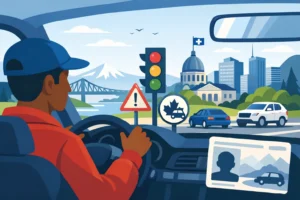
Moving to Quebec often comes with one urgent question: how long can you drive with your current license, and what happens after that? For many newcomers, immigrant driving rules Quebec can feel more stressful than they should. The good news is that the process is manageable once you understand the timelines, the SAAQ requirements, and the difference between driving experience and licensing eligibility.
If you already know how to drive, that does not always mean you can simply keep driving under the same rules you followed in your home country. Quebec recognizes some foreign licenses more easily than others, and in some cases you may need to pass theory tests, road tests, or complete part of the local licensing process. That is where clarity matters. A small misunderstanding about deadlines or documents can delay your license and make daily life much harder.
How immigrant driving rules Quebec usually work
The first thing to know is that Quebec generally allows newcomers to drive with a valid foreign driver’s license for a limited period after arrival. For many immigrants, that window is up to six months, but the exact situation depends on your immigration status, the type of license you hold, and whether your documents are valid and recognized. If your license is expired, damaged, or unsupported by proper identification, that can create problems right away.
After that initial period, you may need to exchange your foreign license for a Quebec license or go through testing. Quebec does have reciprocal agreements with certain countries, which can make the transition simpler. If your country is covered by one of those agreements, you may be able to exchange your license without taking the full testing route, provided your documents meet the requirements.
If your country is not part of a reciprocal agreement, the process is usually less direct. You may need to prove your driving experience, pass a knowledge test, and pass a road test. In some cases, previous experience helps. In others, it reduces very little. That is frustrating for experienced drivers, but it reflects Quebec’s focus on local traffic laws, road signs, winter conditions, and safety standards.
Which newcomers can exchange a foreign license
This is where many people get conflicting advice from friends or social media. Not every foreign license can be exchanged in the same way. The key issue is whether Quebec recognizes your issuing jurisdiction under a reciprocal arrangement and whether your license class matches a passenger vehicle license in Quebec.
Even when an exchange is possible, it is rarely as simple as showing up and getting a new card. You may need proof of residence in Quebec, identity documents, immigration documents, your original license, and in some cases an official translation. If the SAAQ cannot clearly confirm what your license authorizes you to drive or how long you have been licensed, it may ask for additional proof.
That is one reason newcomers should avoid waiting until the last minute. A document that seems minor, such as a driving record or certified translation, can take time to obtain. Starting early gives you room to fix mistakes without interrupting your ability to drive legally.
Experience matters, but proof matters more
A common surprise for immigrants is that years of driving experience only help if you can document them properly. If you have been driving for ten years but cannot prove the original issue date of your license or provide an acceptable driving history, Quebec may not credit that experience the way you expect.
This affects more than paperwork. It can also influence whether you need testing and what stage of the licensing process applies to you. For that reason, newcomers should gather documents before visiting the SAAQ, not after.
When you may need tests instead of a simple exchange
If your license cannot be exchanged directly, you will likely enter a testing path. That usually means a knowledge test first, then a road test if you pass the written portion and meet the eligibility rules. For experienced drivers, the difficult part is often not basic vehicle control. It is adapting to Quebec-specific rules.
School zones, right turns on red rules, four-way stops, winter tire obligations, lane discipline, and pedestrian priority can all be tested in ways that differ from your home country. Even confident drivers can fail when they assume old habits will transfer smoothly.
In practical terms, this is why preparation matters. You are not starting from zero, but you are learning a new legal system. Drivers who treat the process seriously usually perform better than those who rely only on past experience.
Immigrant driving rules Quebec and the graduated licensing system
Some newcomers worry they will have to complete the same full process as a teenager getting licensed for the first time. Sometimes that fear is exaggerated, but sometimes parts of the graduated system do apply. It depends on your age, your driving history, and whether your foreign experience is recognized.
Quebec’s licensing framework is structured and safety-focused. If the SAAQ determines that your previous experience does not meet the requirements for direct licensing, you may need to follow steps that include examinations and waiting periods. For adults, the path may still be shorter than it would be for a true beginner, but it is not automatic.
This is where good guidance can save time. A newcomer with strong driving ability may still need help understanding what the examiner expects, how Quebec road test routes feel, and which mistakes are treated seriously. A local school that works with immigrants regularly can often make the process feel far less overwhelming.
Insurance, registration, and legal driving after arrival
Getting a Quebec license is only one part of driving legally. You also need proper insurance and, if you own a vehicle, valid registration. Newcomers sometimes focus so much on the license issue that they overlook insurance requirements or assume coverage from another country automatically continues. That can be a costly mistake.
Insurance companies in Quebec may also assess your previous driving history differently depending on what proof you can provide. A recognized record of safe driving may help. No proof, or incomplete proof, may mean higher premiums. This is another example of how paperwork affects real-life costs.
There is also a practical side here. If you are planning to buy a car quickly after arriving, it is smart to sort out your license status first. Your legal right to drive, your insurance options, and your budget are all connected.
Preparing for the Quebec knowledge and road tests
For many newcomers, the fastest way to lose confidence is to assume the road test will be easy because they have driven for years. In reality, the test checks whether you drive according to Quebec standards, not whether you have general driving experience.
The knowledge test requires focused study. You need to understand signs, rules, penalties, and safe driving practices specific to Quebec. The road test then puts those rules into action. Examiners look at observation habits, speed management, lane positioning, signaling, stopping technique, and overall judgment.
A short adjustment period can make a big difference. Many experienced immigrant drivers benefit from a few professional lessons, not because they cannot drive, but because they need to correct local rule gaps and remove habits that may lead to automatic errors on the exam.
At Ecole Unity, this is often where newcomers gain the most confidence. A lesson focused on Quebec expectations can turn uncertainty into a clear plan.
Common mistakes newcomers make
The biggest problems are usually not dramatic. Drivers wait too long to begin the process, assume their country has a reciprocal agreement, bring incomplete documents, or underestimate the road test. Others keep driving after their authorized period has ended because they misunderstood the rules.
Another common issue is language stress. Even strong drivers can feel less confident when handling official appointments or test instructions in English or French. Practicing the process ahead of time, including test-style driving, can help reduce that pressure.
The smartest approach for newcomers
If you are new to Quebec, the best first step is to confirm your exact licensing pathway as early as possible. Do not assume your friend’s experience will match yours, even if you came from the same region. Small differences in status, documents, or license history can change the outcome.
From there, think in stages. First, confirm how long you can legally drive with your current license. Next, gather identity documents, proof of residence, your foreign license, and any driving record or translation that may be needed. Then prepare for the exchange or testing route that applies to you.
If testing is required, treat it like a professional transition, not a formality. Study the rules. Practice under Quebec conditions. Learn what examiners expect. That approach usually saves time, money, and frustration.
Starting over in a new place already asks a lot of you. Your driving journey in Quebec should feel structured, not confusing, and the right preparation can turn it into one more step forward with confidence.