

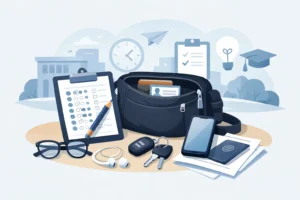
You do not want to figure out what to bring knowledge test day while standing in line at the licensing office. That is how simple mistakes turn into missed appointments, extra stress, and delays you could have avoided. A little preparation makes the day feel much more manageable, especially if this is your first step toward getting licensed in Quebec.
The good news is that the knowledge test itself is only part of the process. The other part is showing up with the right documents, the right payment method, and a clear understanding of what the testing center may ask for. If you are a teenager starting the licensing process, an adult getting a first license, or a newcomer learning how Quebec rules work, knowing what to bring helps you walk in with confidence.
What to bring knowledge test appointments usually require
For most knowledge test appointments, you should expect to bring valid identification, any required proof of legal presence or residency, and a way to pay the required fees if payment is due on site. The exact document combination can vary depending on your age, your status in Quebec, and whether this is your first license application.
That is why it helps to think in categories instead of relying on memory. You will usually need documents that prove who you are, where you live, and that you are eligible to apply. If one document does not cover everything, bring supporting documents as well.
If you are unsure whether a document will be accepted, bring more than one form of identification when possible. It is much easier to carry an extra document than to reschedule your test.
Government-issued ID
Your ID should be current, legible, and official. In many cases, applicants bring a birth certificate, passport, health card, permanent resident card, or another accepted government document. Names should match across documents. If your name appears differently on one record, that can slow things down or create questions at check-in.
Teen applicants may also need to follow age-specific requirements. Adults and newcomers may be asked for different supporting records depending on their immigration or residency status. This is one of those situations where details matter.
Proof of residency
Some applicants need to show proof that they live in Quebec. A document with your full name and current address may be required. Utility bills, government letters, school records, or lease-related documents are often the types people ask about, but accepted documents can vary by case.
If you recently moved, be careful. An old address on your paperwork can create problems, even if everything else is correct. Check your documents a few days before the test so you still have time to replace or print anything you need.
Payment method
Many people focus so much on documents that they forget about fees. Bring a payment method that the testing location accepts. If you are not sure whether they take debit, credit, or another form of payment, confirm in advance. Do not assume every location handles payment the same way.
This may seem minor, but it is one of the most common avoidable issues on test day. You can know the rules perfectly and still lose time if payment becomes a last-minute problem.
What to bring to a knowledge test if you are a newcomer
If you are new to Quebec or new to Canada, the question of what to bring to a knowledge test deserves extra attention. Newcomers often have valid documents, but not always in the format the licensing process expects.
You may need to bring immigration documents, proof of legal status, passport identification, and local proof of address. If you already held a license in another country, bring that too, even if it does not replace the need for testing. Prior driving experience can still matter during the licensing process.
Language can also be a factor. If any of your documents are not in English or French, check whether certified translation is required. This depends on the document and the authority reviewing it. It is always better to verify before test day than to hope the paperwork will be accepted.
For many newcomers, the hardest part is not the test content. It is simply understanding the system. A structured prep approach can make that process much less stressful.
What not to forget before you leave home
Beyond documents, there are a few practical items worth bringing because they help the day go more smoothly. Your appointment confirmation is one of them, whether printed or saved on your phone. If the testing center has trouble locating your booking, having proof of your appointment can save time.
You should also bring glasses or contact lenses if you use them. Even if you are coming for the knowledge test, vision requirements may still be part of the appointment process. Do not leave corrective lenses at home and expect to manage without them.
Bring a charged phone, but do not plan to use it during the test. It can help with directions, appointment records, and emergency communication, but testing rooms usually have strict rules about devices. Keep it available, then put it away when instructed.
It is also smart to bring water and arrive a little early. Rushing into a test center after struggling with parking or public transit is not the mindset most people want before an exam.
A quick checklist for what to bring knowledge test day
If you want one simple reference, make sure you have:
- Your appointment confirmation
- Valid government-issued identification
- Proof of residency if required
- Immigration or legal status documents if applicable
- Payment method for any fees
- Glasses or contacts if you need them
This list covers the basics, but your personal situation may require more. First-time applicants, minors, and newcomers should be especially careful to review any requirements tied to their status.
Common mistakes that cause delays
The most common problem is bringing incomplete documents. A person may have photo ID but no address proof, or they may bring paperwork with mismatched names. Another frequent issue is assuming a photocopy will be accepted when the office wants an original document.
Arriving late is another avoidable mistake. Even if you are only a few minutes behind, your appointment may need to be rescheduled depending on the location and schedule. Give yourself buffer time for traffic, parking, or transit delays.
Some learners also underestimate how nervous they will feel. If that sounds like you, prepare your documents the night before and place them in one folder. That way, the morning feels organized instead of rushed.
How to feel ready, not just prepared
Bringing the right documents matters, but confidence also comes from knowing what to expect. If you have studied Quebec road signs, rules, penalties, and safe driving habits, the knowledge test becomes far less intimidating. You are not trying to guess your way through it. You are showing what you have learned.
That is especially true for beginners and adults returning to study after a long break. Test anxiety is normal. What helps is structure. When learners practice with realistic questions and review the reasoning behind the rules, they usually feel more in control.
At Ecole Unity, we see this often. Students who understand both the material and the process tend to arrive calmer and perform better because fewer things feel uncertain.
Before test day, verify the details once more
Requirements can change, and specific cases can come with extra paperwork. That is why the best final step is a simple one: review your appointment details and confirm exactly what your testing center expects from someone in your situation.
If you are under 18, a first-time applicant, a newcomer, or someone with documents from outside Quebec, do not rely on general advice alone. Use it as a starting point, then verify the details for your case.
Getting your learner’s permit is a big step, and it should feel like progress, not confusion. Set out your documents, plan your route, get a good night of sleep, and walk in knowing you gave yourself every advantage.