

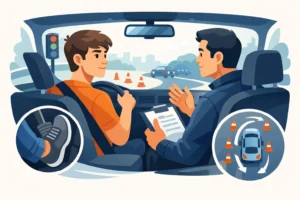
Your first time behind the wheel may feel bigger than it is. Searches for what happens during first driving lesson often come from people imagining busy Montreal traffic, difficult parking, or an instructor expecting them to know the basics already. In reality, a well-planned first lesson is designed to slow things down, explain each step clearly, and help you feel safe before the car moves.
For most complete beginners, the goal is not to drive perfectly or cover a long distance. It is to become familiar with the vehicle, understand your instructor’s guidance, and take your first controlled steps toward becoming a safe, confident driver.
Before the car starts moving
Your instructor will usually begin by getting to know your experience level. Be honest, whether you have never sat in a driver’s seat, practiced with family in another country, or drove years ago and need a refresher. This helps the instructor choose the right pace and avoid assumptions that can make a new driver feel pressured.
In Quebec, your lesson may also include a quick check that you have the appropriate learner’s permit and understand the conditions attached to it. If you are a newcomer, this is a useful time to ask questions about local signs, right-of-way rules, winter driving expectations, and the SAAQ licensing process. Rules that feel familiar from another country may work differently here.
The instructor will explain how the lesson car is set up and what they can do to keep the session safe. Training vehicles commonly have an instructor brake, allowing the instructor to intervene when necessary. That safety measure means you can focus on learning instead of worrying that one small mistake will put you or someone else at risk.
Getting comfortable in the driver’s seat
Before you drive, you will learn how to set up the car for control and visibility. This is not a minor detail. A seat that is too far back, a poorly adjusted mirror, or hands placed awkwardly on the steering wheel can make every later task harder.
Your instructor will show you how to adjust the seat so that you can press the brake firmly while keeping a slight bend in your knee. You will adjust the steering wheel if needed, position the head restraint, fasten your seat belt, and set the rearview and side mirrors. You will also identify the accelerator, brake, gear selector, parking brake, turn signals, windshield wipers, headlights, and hazard lights.
For a first lesson, take your time with this part. You are building a routine that should happen every time you drive, including when you are nervous, tired, or in a rush. Safe driving starts before the vehicle is in gear.
Learning the basic controls
Most beginner lessons use an automatic vehicle, so you will generally focus on brake control, gentle acceleration, steering, signaling, and looking where you intend to go. Your instructor may ask you to practice moving the gear selector from Park to Drive while holding the brake, then explain when Reverse and Neutral are used.
You may be surprised by how sensitive the pedals feel. That is normal. New drivers often press the brake too firmly or accelerate more than intended at first. The instructor will encourage smooth, gradual movements rather than fast corrections. Precision comes with repetition, not force.
What happens during a first driving lesson on the road
Once you are ready, the instructor will normally choose a quiet, low-pressure area such as a residential street or parking lot. The first few minutes may involve simply releasing the brake, allowing the car to roll slowly, and bringing it to a controlled stop. This gives you a chance to understand the car’s movement without managing heavy traffic.
From there, you may practice driving straight, steering through gentle turns, stopping at intersections, and checking your surroundings. Your instructor will talk you through the steps out loud: check mirrors, look ahead, scan for pedestrians, signal, brake smoothly, and turn when it is safe.
Do not expect to handle highways, complex downtown intersections, parallel parking, or fast lane changes during your first session. Those skills need a stronger foundation. Starting in a simpler environment is not a sign that you are behind. It is how safe driver education is supposed to work.
You will also begin learning that driving is about observation, not just controlling the car. A beginner often concentrates so hard on steering that they forget to scan the road. Your instructor may repeatedly remind you to look well ahead, check mirrors, watch for cyclists, and notice parked cars that could open a door. Those reminders are part of the learning process.
Mistakes are expected, not judged
Stalling is less common in an automatic car, but sudden braking, wide turns, missed signals, and uncertainty at stop signs are all common in early lessons. An experienced instructor expects these moments. What matters is that you listen, correct the issue, and understand why it happened.
For example, if you turn too wide, the instructor may explain how looking farther into the turn helps guide the steering wheel. If you stop abruptly, they may show you how to begin braking earlier and reduce pressure as the car slows. Each correction gives you a usable skill for the next attempt.
Try not to apologize for every small error. Ask a question instead. You might say, “When should I start braking for that stop sign?” or “How do I know if I have enough space to turn?” Good questions help your instructor tailor the lesson to you.
Your first lesson is also a safety lesson
A driving lesson is never only about operating a vehicle. You will begin developing habits that protect you, your passengers, pedestrians, cyclists, and other drivers. In Montreal and surrounding communities, that includes paying close attention to school zones, bus stops, changing weather, dense parking, and vulnerable road users.
Your instructor may introduce the idea of keeping a safe following distance, maintaining a proper speed for conditions, and leaving space around the vehicle. Even if you are driving slowly on a quiet street, these habits matter. They become much easier to use in busy traffic when they are practiced from day one.
Quebec weather can add another layer of learning. Your first lesson may happen in clear conditions, rain, snow, or low light. The exact plan will depend on conditions and your comfort level. A professional instructor will not push a complete beginner into a situation that is unsafe, but learning how weather changes braking distance and visibility is valuable preparation.
What you should bring and how to prepare
Bring your learner’s permit, wear comfortable shoes with a thin, secure sole, and avoid footwear that can slip off or catch under a pedal. Arrive a few minutes early so you are not beginning the lesson rushed. If you wear glasses or contact lenses for driving, bring them.
It also helps to arrive with a simple mindset: you do not need to prove that you are naturally good at driving. You only need to be present, follow instructions, and give yourself permission to learn gradually. Eat beforehand if you can, silence your phone, and let your instructor know if you feel particularly anxious.
If English or French is not your first language, tell the school. Clear instruction matters, especially when learning traffic rules and safety procedures. Ecole Unity works with beginners and newcomers who need patient, structured support as they learn Quebec driving expectations.
What happens after your first driving lesson
At the end of the session, your instructor will usually review what you practiced, point out what went well, and identify one or two skills to focus on next time. You may receive guidance on course progression, theory study, or practice requirements based on your licensing stage.
Some students leave feeling excited. Others feel mentally tired, especially after concentrating on mirrors, pedals, signs, steering, and instructions all at once. Both reactions are normal. Driving uses attention in a new way, and your confidence will grow as tasks become more familiar.
The most helpful next step is to remember one improvement from the lesson rather than replaying every mistake. Maybe you learned to brake more gently, look farther ahead, or make smoother turns. That small progress is the beginning of a safer, smarter driving future.