

Free SAAQ Knowledge Test Practice Questions (2026)
The best way to prepare for the SAAQ knowledge test isn’t just reading the guide — it’s testing yourself. Below you’ll find sample practice questions from all three modules, formatted exactly like the real exam.
Work through them, check your answers, and pay attention to the explanations. Understanding why an answer is correct matters more than memorizing the right letter.
Module 1 Practice Questions — Road Signs & Signals
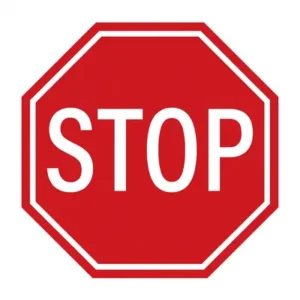
Question 1 You see an octagonal red sign at an intersection. What must you do?
- A) Slow down and proceed if the road is clear
- B) Stop completely, yield to all traffic, then proceed when safe
- C) Stop only if other vehicles are present
- D) Yield to pedestrians only
✅ Answer: B — A stop sign requires a complete stop. You must yield to all traffic and pedestrians before proceeding, regardless of whether anyone appears to be present.
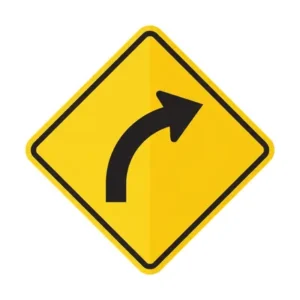
Question 2 A diamond-shaped yellow sign with a curved arrow means:
- A) Road narrows ahead
- B) Curve in the road ahead
- C) Merge lane ahead
- D) Bicycle crossing
✅ Answer: B — Diamond-shaped yellow signs are warning signs. A curved arrow indicates a curve ahead — reduce speed appropriately.
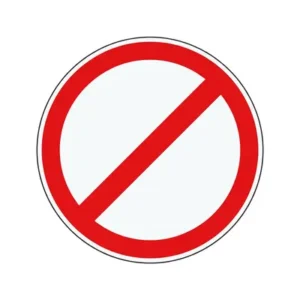
Question 3 What does a sign with a red circle and a diagonal line through it indicate?
- A) A hazard is present
- B) The action shown in the sign is prohibited
- C) Slow down
- D) Temporary restriction in effect
✅ Answer: B — A red circle with a diagonal line means the depicted action is forbidden at that location.
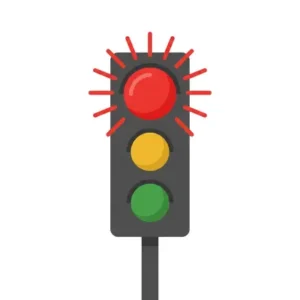
Question 4 A flashing red traffic light should be treated as:
- A) A yield sign
- B) A stop sign
- C) A warning to slow down
- D) An inoperative light — proceed with caution
✅ Answer: B — A flashing red light requires a full stop, just like a stop sign. Come to a complete stop, yield to all traffic and pedestrians, then proceed.
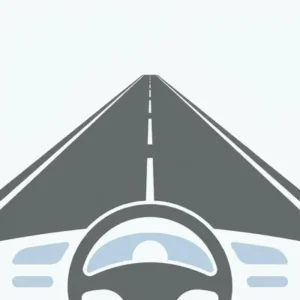
Question 5 White lane markings on a road indicate:
- A) Traffic flowing in opposite directions
- B) Traffic flowing in the same direction
- C) The edge of the road
- D) A bike lane
✅ Answer: B — White markings separate lanes of traffic moving in the same direction. Yellow markings separate opposing traffic flows.
Module 2 Practice Questions — Rules of the Road
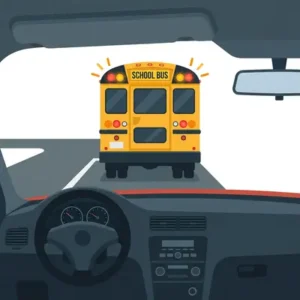
Question 6 When approaching a school bus with flashing amber lights, you must:
- A) Stop immediately
- B) Slow down and prepare to stop
- C) Pass carefully
- D) Honk to warn children
✅ Answer: B — Flashing amber lights mean the bus is about to stop. Slow down and be ready to stop. When the red lights flash, you must stop completely (on all roads except divided highways, where oncoming traffic is not required to stop).
Question 7 You are approaching an intersection with no traffic signals or signs. Who has the right of way?
- A) The driver travelling faster
- B) The driver who arrived first
- C) The driver on the left
- D) The driver going straight
✅ Answer: B — At an uncontrolled intersection, the first driver to arrive has the right of way. If two vehicles arrive simultaneously, yield to the driver on your right.
Question 8 What is the minimum following distance you should maintain behind another vehicle under normal conditions?
- A) One car length
- B) Two seconds
- C) Three seconds
- D) Five car lengths
✅ Answer: C — The SAAQ recommends at least a 3-second following distance under normal conditions. Increase this in bad weather, at night, or with heavy vehicles.
Question 9 You want to change lanes on a highway. What is the correct procedure?
- A) Check your mirror, signal, and change lanes
- B) Signal, check your mirror, check your blind spot, then change lanes
- C) Check your blind spot, then change lanes without signalling on a highway
- D) Signal for 2 seconds, then change lanes
✅ Answer: B — Signal first, check your mirrors, then physically check your blind spot before moving. Skipping the blind spot check is one of the most common causes of sideswipe collisions.
Question 10 In Quebec, when must you use your headlights?
- A) Only at night
- B) From dusk to dawn and whenever visibility is poor
- C) Only in fog
- D) Whenever you are on a highway
✅ Answer: B — Quebec law requires headlights from dusk to dawn and in any condition where visibility is reduced (rain, fog, snow, etc.).
Module 3 Practice Questions — Attitudes & Driver Behaviour
Question 11 You are driving and feel very tired. What should you do?
- A) Open your window to stay alert
- B) Turn on the radio
- C) Pull over safely and rest
- D) Drink coffee at the next stop
✅ Answer: C — Drowsy driving is as dangerous as impaired driving. The only safe solution is to pull over and rest. Rolling down a window or turning on music provides only brief, unreliable relief.
Question 12 A driver behind you is following too closely (tailgating). What should you do?
- A) Brake suddenly to show you need more space
- B) Speed up to create distance
- C) Maintain your speed and increase your following distance from the vehicle ahead
- D) Pull over and let them pass
✅ Answer: C — Braking suddenly creates a collision risk. The correct response is to increase your own following distance ahead, giving you more reaction time if you need to slow down — which reduces the risk to everyone. If the situation feels dangerous, D (pulling over when safe) is also acceptable, but C is the textbook answer.
Question 13 You are involved in a collision where someone is injured. What is your first obligation?
- A) Call your insurance company
- B) Move your vehicle out of traffic
- C) Stop and provide assistance to injured persons
- D) Wait for police to arrive
✅ Answer: C — Quebec law requires you to stop and provide assistance to any injured person. Leaving the scene of a collision involving injuries is a serious criminal offence.
Question 14 Which of the following is NOT an effect of alcohol on driving ability?
- A) Reduced reaction time
- B) Improved night vision
- C) Impaired judgment
- D) Overconfidence
✅ Answer: B — Alcohol impairs all aspects of driving — it does not improve night vision. All other options are real and documented effects.
Question 15 When is it acceptable to use a hand-held cell phone while driving?
- A) At a red light
- B) On a one-way street with light traffic
- C) Never, unless hands-free
- D) Only for a call shorter than 30 seconds
✅ Answer: C — In Quebec, using a hand-held device while driving is prohibited at all times, including when stopped at a red light. Only hands-free use is permitted.
How Did You Do?
- 12–15 correct: You’re well-prepared. Take a full practice run and book your test.
- 8–11 correct: Review the modules you struggled with using the SAAQ Guide de la route.
- Under 8 correct: Don’t rush. Take more time with the guide and re-test before booking.
Prepare With a Driving Course
Practice questions help, but nothing replaces structured learning. Our theory sessions at École Unity cover all three modules in detail, with real-world examples and time to ask questions — in a classroom setting that makes the material stick.
Students who complete our theory course before their SAAQ knowledge test pass at a significantly higher rate.