

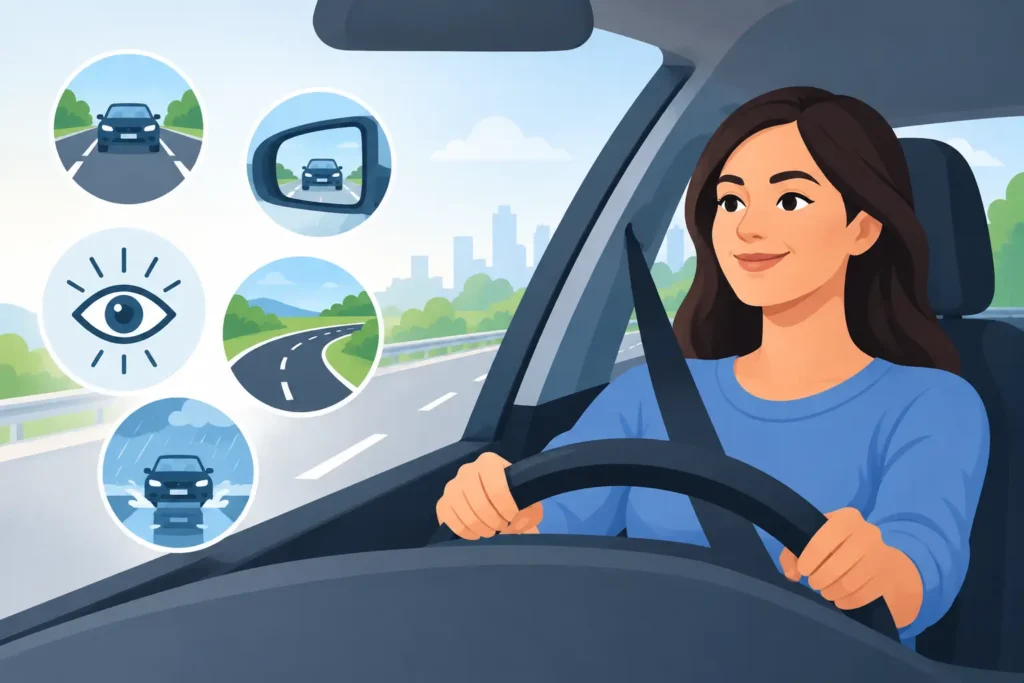
A road test can feel like a series of isolated tasks: stop correctly, change lanes, park, turn. Real driving is different. You must read traffic, predict mistakes, manage space, and stay calm when something changes quickly. Defensive driving exercises turn those skills into habits, giving new Quebec drivers a practical way to build confidence before the SAAQ road test and long after it.
For beginners, the goal is not to drive nervously or assume every other driver will make a mistake. It is to notice risks early enough that you have time and room to respond safely. The best practice happens gradually, on routes and at speeds that match your current experience.
What Defensive Driving Really Means
Defensive driving means actively protecting yourself, your passengers, pedestrians, cyclists, and other road users. You follow the rules, but you also prepare for situations where another person may be distracted, rushed, confused, or unable to see you.
A green light, for example, gives you the right to proceed. It does not guarantee that an oncoming vehicle will stop for a red light. A clear lane may appear open, but a car in your blind spot can be hidden from your mirrors. Defensive drivers do not panic about these possibilities. They scan, leave space, and make decisions with a safety margin.
That margin matters in Montreal, where dense traffic, winter weather, construction zones, cyclists, buses, and unfamiliar intersections can all demand extra attention. Good driving is not about reacting at the last second. It is about recognizing patterns early.
Defensive Driving Exercises for New Drivers
These exercises work best during supervised practice with a qualified instructor or an experienced accompanying driver who understands Quebec rules. Do not turn a public road into a practice course. Choose legal, low-pressure conditions first, then add complexity as your control and awareness improve.
Build a scanning routine
Many new drivers focus too closely on the vehicle directly ahead. Practice moving your eyes continuously: far ahead for developing traffic conditions, near the road for immediate hazards, mirrors for surrounding vehicles, then back ahead. There is no need to count every glance. The purpose is to avoid staring in one place for too long.
On a familiar street, have your instructor ask simple questions while you drive: What is happening at the next intersection? Where is the nearest pedestrian? Which vehicle could enter your lane? This exercise teaches you to gather information without taking your focus off the road.
At first, verbalizing what you see can feel distracting. Use it only with supervision and at an easy pace. As the routine becomes natural, you will scan quietly and make smoother decisions.
Practice the space cushion
Following too closely removes your options. Pick a fixed point ahead, such as a sign or pole. When the vehicle in front passes it, count at a calm pace until you reach the same point. In normal dry conditions, aim for at least a three-second following distance. Increase that distance in rain, snow, slush, darkness, heavy traffic, or when visibility is limited.
Next, notice the space beside and behind your vehicle. If a driver is following too closely, avoid braking sharply unless necessary. Maintain a steady speed, create more room ahead, and change lanes or let the vehicle pass when it is safe and legal. The exercise is about giving yourself choices, not trying to correct someone else’s driving.
Use the SIPDE decision cycle
A useful defensive-driving routine is SIPDE: Scan, Identify, Predict, Decide, and Execute. It gives beginners a clear way to process busy situations.
Imagine you are approaching a crosswalk near a parked delivery van. Scan the road and sidewalks. Identify that the van blocks your view of pedestrians. Predict that someone may step out unexpectedly. Decide to reduce speed and cover the brake. Execute smoothly while checking your mirrors and keeping your lane position.
Practice this cycle out loud on quiet routes with an instructor, then use it mentally in busier areas. It is especially helpful at intersections, near school zones, and around parked cars where visibility can change quickly.
Rehearse safe intersection entries
Intersections are a frequent source of conflict because several road users may move at once. On each approach, practice checking the signal, signs, lane markings, crosswalks, and traffic on both sides. Before entering on a green light, look left, center, and right for late vehicles, pedestrians, or cyclists.
When making a left turn, wait until you have a safe gap and keep your wheels straight while waiting. Turning the wheels early can push your vehicle into oncoming traffic if you are hit from behind. When turning right, check mirrors and the right-side blind area for cyclists or pedestrians before moving.
This is not about hesitating unnecessarily. It is about entering with a clear view and a safe plan. During an SAAQ road test, controlled observation and correct right-of-way decisions show the examiner that you can manage risk.
Make lane changes predictable
A safe lane change begins before you touch the steering wheel. Practice the sequence: check the road ahead, check mirrors, signal early, check the blind spot with a quick shoulder glance, then move gradually when the lane is clear. Cancel the signal once the move is complete.
A helpful exercise is to identify your escape space before changing lanes. Ask yourself where you will go if traffic slows suddenly. If there is no safe opening, stay in your lane. Missing a turn or taking the next exit is always better than forcing your way into traffic.
Avoid treating a signal as permission. It is communication, not a guarantee that another driver will make room.
Train for smooth braking and stopping
Hard braking is sometimes necessary, but a defensive driver tries to avoid surprises through early observation. On a quiet, legal route, practice releasing the accelerator early when you see a red light, stopped traffic, or a developing hazard. Brake progressively, leaving enough distance to see the rear tires of the vehicle ahead touching the road.
This stopping position gives you room to maneuver if needed and reduces the chance of a minor collision in slow traffic. It also helps you avoid rolling forward unintentionally at intersections.
In wet or winter conditions, braking distances increase. Quebec learners should experience these conditions only when they are ready and accompanied by an instructor who can guide them. The lesson is not to test the limits of traction. It is to slow down sooner and adjust your following distance before you need to brake.
Practice hazard recognition without distractions
Before each drive, choose one hazard category to watch for: pedestrians, cyclists, opening car doors, work zones, or vehicles backing out of driveways. You are not ignoring everything else. You are training your brain to spot one common risk faster.
For example, when driving beside parked cars, look for occupied vehicles, brake lights, wheels turned outward, and people near door handles. Around buses, watch for passengers crossing in front. Near construction, expect lane shifts, workers, uneven pavement, and instructions that may change from one block to the next.
Do not use your phone to record, time, or track these exercises while driving. Set navigation, music, and messages before leaving. Attention is your most valuable safety tool.
How to Progress Without Overloading Yourself
Start with one or two skills per lesson. A new driver may first practice scanning and following distance on quieter roads, then add intersections, lane changes, and heavier traffic over several sessions. Trying to correct every habit at once can create stress and make your driving less consistent.
After each practice drive, take a few minutes to reflect. Which situations felt controlled? When did you feel rushed? Did you see hazards early, or only after you were close to them? Specific answers help you and your instructor choose the next exercise.
A professional lesson can make this feedback much more useful. At Ecole Unity, personalized practical instruction helps learners connect defensive habits with Quebec road rules, everyday driving, and SAAQ test expectations.
Defensive Driving Is More Than Passing the Test
The road test measures whether you can drive safely on a particular day. Defensive habits are what help you handle the unexpected afterward: a child chasing a ball, a driver changing lanes without signaling, black ice near an intersection, or a pedestrian stepping between parked cars.
Confidence does not come from assuming nothing will go wrong. It grows when you know how to observe, create space, and respond calmly. Practice these exercises patiently, ask for feedback, and let every supervised drive move you one step closer to being the safe, capable driver you want to become.