

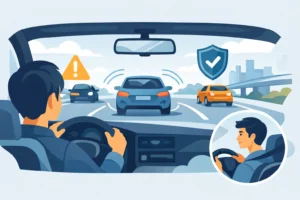
A green light changes, the car behind you starts moving, and a pedestrian is still stepping off the curb. Moments like this are where defensive driving for newcomers becomes more than a lesson from a handbook. It is the habit of giving yourself time, space, and options before a situation becomes stressful.
For people who are new to driving or new to Quebec, the challenge is often bigger than steering and parking. You may be learning unfamiliar signs, adapting to busy Montreal streets, or understanding how local drivers respond to snow, cyclists, school zones, and construction. Defensive driving helps turn those unknowns into clear decisions.
What Defensive Driving Really Means
Defensive driving means driving with the expectation that other road users may make mistakes, be distracted, or be hard to see. It does not mean being fearful, overly slow, or suspicious of everyone around you. It means staying alert and leaving enough room to respond calmly.
A defensive driver looks beyond the vehicle directly ahead. They scan intersections before entering them, check mirrors regularly, notice cars preparing to merge, and reduce speed when visibility or road conditions change. Instead of reacting at the last second, they plan ahead.
This approach is especially valuable for newcomers. Rules may be similar to those in another country or state, but daily driving culture can differ. Right turns, lane discipline, pedestrian behavior, winter maintenance, and school-zone enforcement all require attention to local conditions. A professional course gives you a safe place to practice those decisions before you need to make them alone.
Defensive Driving for Newcomers Starts With Space
Following too closely is one of the easiest ways to lose your safety margin. When you leave a proper gap, you can see more of the road, brake gradually, and avoid copying the sudden movements of the driver ahead.
Use the three-second rule in normal, dry conditions. Pick a fixed object such as a sign or light pole. When the vehicle ahead passes it, count three seconds. If you reach the same point before you finish counting, ease off the accelerator and create more distance.
Three seconds is a starting point, not a permanent rule. Increase your following distance in rain, snow, fog, darkness, heavy traffic, or when driving behind a large vehicle that blocks your view. If you are still developing smooth braking control, extra space is a practical advantage, not a sign that you lack confidence.
Space also matters beside and behind your vehicle. Avoid driving for long periods in another car’s blind spot. If someone follows too closely, do not brake suddenly to send a message. Keep your attention ahead, maintain a steady pace, and change lanes or let them pass when it is safe and permitted.
Build a Scanning Routine Before Every Maneuver
Many new drivers focus so intensely on the lane in front of them that they miss the wider picture. A reliable scanning routine reduces surprises and helps you make smoother choices.
Look well ahead, not only at the bumper in front of you. In city traffic, watch for brake lights several cars ahead, people approaching crosswalks, buses pulling away from stops, and vehicles that may turn across your path. At intersections, look left, center, and right even when you have a green light. A green signal gives you the right to proceed, but it does not guarantee that another driver will stop.
Check your mirrors every few seconds and before slowing, turning, changing lanes, or opening a door. Mirrors show what is happening behind you, but they do not remove blind spots. Before changing lanes, signal early, check mirrors, and make a quick shoulder check in the direction you plan to move. This sequence is simple, but it must become automatic.
Keep your eyes moving without staring at one hazard for too long. If you fixate on a parked car, a pothole, or an approaching vehicle, you may unintentionally steer toward it. Notice the risk, look toward the open path you want to take, and guide the vehicle smoothly.
Intersections Need Extra Patience
Intersections combine pedestrians, cyclists, turning vehicles, traffic signals, and limited sightlines. They deserve your full attention. Slow down early when approaching a stale green light, which is a light that has been green for some time and may change soon.
Before making a turn, check for people crossing in the crosswalk and cyclists traveling beside traffic. Do not let a driver behind you pressure you into turning before the path is clear. Waiting a few extra seconds is always better than forcing a risky gap.
When your view is blocked by a large truck, parked vehicle, snowbank, or building, reduce speed and be ready to stop. You cannot safely assume that a hidden area is empty.
Adjust Your Driving to Quebec Conditions
The safest driving choice depends on the road, weather, traffic, and your level of experience. A posted speed limit is the maximum allowed under favorable conditions, not a promise that the road is safe at that speed.
Montreal-area roads can change quickly. Construction zones may shift lanes, narrow streets may have parked cars on both sides, and potholes can affect vehicle control. Read signs early and choose your lane before the last moment. Sudden lane changes are harder for other drivers to predict and can create problems during an SAAQ road test.
Winter calls for a larger safety margin. Snow and ice increase stopping distance, while slush can pull at the tires and reduce steering response. Accelerate gently, brake earlier, and make turns at a speed that allows you to stay in control. Clear all snow, ice, and fog from your windows before moving. A small cleared area on the windshield is not enough when you need to see pedestrians, signs, and traffic from every angle.
In rain, standing water can reduce traction and hide road markings or potholes. Keep both hands ready on the wheel, avoid sharp inputs, and do not use cruise control when conditions are slippery. If visibility is poor, slow down enough that you can stop within the distance you can clearly see.
Manage Pressure From Other Drivers
New drivers often make unsafe choices because they feel rushed. Someone may honk when you pause before a turn, follow closely when you are driving at an appropriate speed, or try to pass aggressively. Their impatience does not change what is safe or legal.
Your job is to drive predictably. Signal in advance, keep a steady speed, and avoid abrupt braking unless there is an immediate hazard. If you miss a turn or exit, continue safely and reroute later. Trying to correct a mistake at the last second can put you, your passengers, and others at risk.
Defensive driving also means managing your own state of mind. Do not begin a drive when you are overly tired, angry, rushed, or distracted by a phone. Set up navigation before putting the vehicle in motion. If you need to adjust it, pull over safely first. Good judgment starts before the car moves.
Practice Decisions, Not Just Parking
Parking, parallel parking, and three-point turns matter, especially when preparing for a road exam. But confident drivers also practice judgment: when to wait, when to yield, when to slow down, and when not to proceed.
During lessons, ask your instructor to explain what they are watching for at each intersection or lane change. Say your observations out loud when appropriate: “Pedestrian near the crosswalk,” “car entering from the right,” or “road is wet, so I am leaving more space.” This helps connect what you see with the action you take.
Practice on different roads and at different times. A quiet residential street helps you develop vehicle control, while a busier route helps you learn scanning and lane planning. The goal is not to seek stressful situations too early. It is to add complexity gradually, with enough guidance to learn from each drive.
At Ecole Unity, structured lessons can help learners build these habits while preparing for Quebec licensing requirements and the SAAQ road test. The strongest preparation is not memorizing a route. It is learning to recognize risks wherever the test, or everyday life, takes you.
A Safer Habit for Every Drive
Before starting the engine, give yourself a simple intention: stay observant, leave room, and never let another driver’s behavior decide your next move. With practice, defensive driving stops feeling like a checklist. It becomes the calm, confident way you protect yourself and everyone sharing the road.