

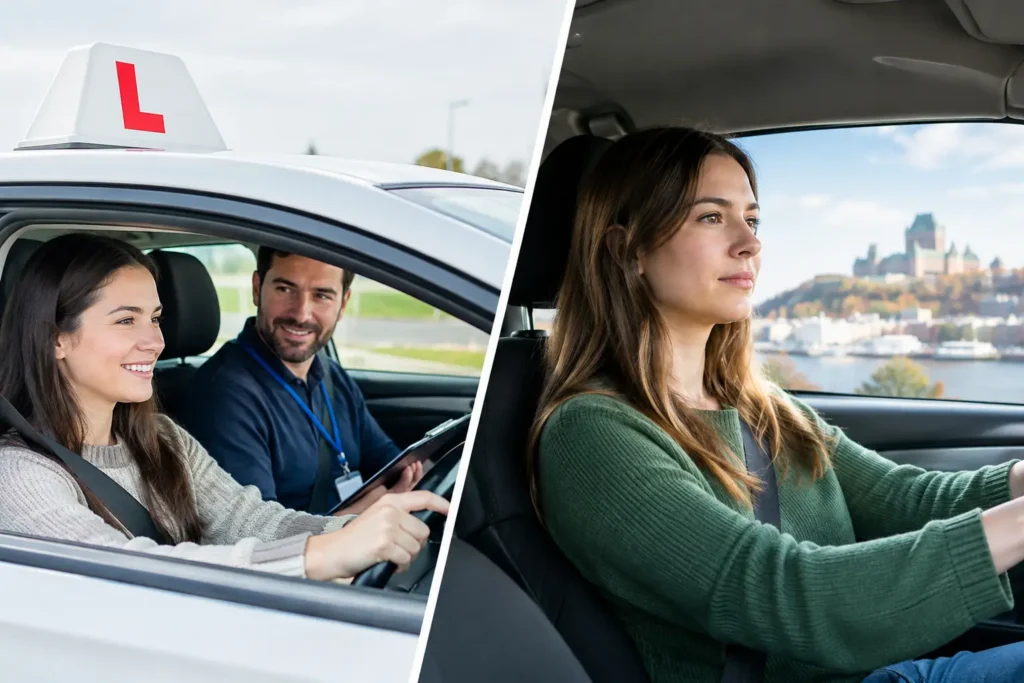
The first time you merge onto a busy Montreal street, check for cyclists, read a construction detour, and keep track of your speed, driving can feel like a lot at once. That is why the choice between driving school versus private practice matters. These are not competing paths where one has to replace the other. For most new Quebec drivers, structured instruction and regular supervised practice work best together.
A driving school gives you a certified learning path, professional feedback, and preparation for Quebec’s licensing process. Private practice gives you repetition, familiarity, and time to turn new skills into natural habits. Knowing what each option can and cannot do helps you invest your time and budget wisely.
Driving School Versus Private Practice: The Key Difference
A driving school teaches you how and why to drive safely within a planned curriculum. Lessons are led by an instructor who watches for patterns that a new driver may not notice: braking too late, looking only at the car ahead, entering an intersection without a full scan, or hesitating at the wrong moment. The goal is not simply to get the car moving. It is to build sound judgment.
Private practice is time behind the wheel with a qualified accompanying driver, often a parent, relative, or trusted friend. It lets you repeat what you learned in lessons under real conditions. You can practice the route to school, parallel park near home, or drive in light rain when traffic is manageable. That repetition is valuable because confidence comes from doing, not only listening.
The difference is structure. School lessons follow a progression, while private practice is only as organized as the person supervising it. A helpful practice partner can reinforce good habits. An impatient or distracted one can make a beginner anxious or unintentionally pass along habits that do not match Quebec rules or SAAQ test expectations.
What a Certified Driving School Gives You
Quebec’s Class 5 licensing process includes mandatory driver education. A certified school is not an optional extra for someone starting from zero. It provides the required course pathway, including theory and practical training, along with the documents and milestones needed as you progress through the licensing stages.
Professional instruction also creates a calmer learning environment. An instructor is there to coach, not to judge. If you stall, miss a mirror check, or make an awkward parking attempt, the lesson continues with clear feedback and another chance to improve. This is especially reassuring for adult beginners, newcomers who are learning local road rules, and students who have had a stressful early experience with driving.
Clear preparation for Quebec roads and tests
Learning to drive in Quebec involves more than controlling a vehicle. You need to understand signs, right-of-way rules, school zones, winter conditions, sharing the road with pedestrians and cyclists, and the decisions expected during an SAAQ road test. A formal course connects classroom knowledge to real driving situations.
This is particularly useful for immigrants and newcomers. Driving experience from another country can be helpful, but local rules, road markings, turning procedures, and testing standards may be different. A qualified instructor can identify which skills transfer well and where you need to adjust.
Feedback that catches small problems early
New drivers often do not realize they are developing risky habits. For example, you may check mirrors but fail to make a clear shoulder check before changing lanes. You may stop fully at a sign but position the car where your view is blocked. These details can affect safety every day and may also affect your road test result.
An instructor can break a difficult task into manageable steps, explain what the examiner is looking for, and measure your progress over several lessons. That kind of specific feedback is difficult to get from occasional practice alone.
Where Private Practice Makes a Real Difference
A scheduled driving lesson is focused and productive, but it is limited in time. Private practice fills the space between lessons. It allows you to reinforce steering, lane position, smooth braking, observation, parking, and route planning until those actions require less conscious effort.
The best practice sessions have a simple purpose. Instead of driving around without a plan, choose one or two skills. One day might focus on smooth starts and stops in a quiet neighborhood. Another might focus on left turns at intersections, highway entry, or backing into a parking space. Short, frequent sessions are often more effective than one long drive that leaves a beginner overwhelmed.
Private practice also exposes you to normal variations that cannot always appear in a lesson: evening glare, a crowded grocery store parking lot, wet pavement, or an unfamiliar route. These conditions help you become adaptable while you still have supervision beside you.
That said, practice should never be rushed. Follow the current SAAQ rules for learner drivers, including requirements for your accompanying driver and the conditions under which you may drive. Before heading out, agree on the route, keep distractions away, and make sure the supervising driver is prepared to give calm, timely directions.
When Private Practice Alone Falls Short
Private practice can be affordable and convenient, but it does not replace the required certified program in Quebec. It may also leave gaps if your supervising driver cannot explain the rules, rarely drives in the conditions you need to learn, or is unavailable often enough for steady progress.
There is another challenge: familiar routes can create false confidence. You may feel comfortable driving the same streets near home but struggle when asked to interpret an unfamiliar intersection, safely change lanes in traffic, or park under test pressure. Road test readiness means you can make safe decisions in changing conditions, not just repeat a route you know.
Some students also receive conflicting advice from different family members. One person may tell you to creep forward at an intersection, while another tells you to wait far back. Rather than guessing, bring those questions to your instructor. Consistent guidance makes learning less confusing.
How to Combine Lessons and Practice Effectively
The strongest approach is to use your school lessons to learn a skill correctly, then use private practice to repeat it safely. After each lesson, ask your instructor what to work on before the next one. A focused practice goal makes the time in the car much more useful.
For example, if your lesson covered lane changes, practice the full routine: mirrors, signal, shoulder check, safe space, smooth movement, and canceling the signal. If you worked on parking, practice in low-pressure spaces before attempting busy downtown streets. Do not practice a maneuver until you are frustrated. Pause, discuss what happened, and try again when you are calm.
Keep a simple record of your drives as well. Note the weather, location, skills practiced, and anything that felt difficult. Over time, you will see progress that may not be obvious from one session to the next. You will also have useful questions ready for your next lesson.
For learners who need extra support before the knowledge test or road exam, targeted preparation can close the final gaps. Ecole Unity offers structured driver education and personalized practical support designed around Quebec’s licensing requirements, including help for beginners and newcomers preparing for the SAAQ process.
Choosing the Right Balance for Your Situation
If you are a complete beginner, start with the formal program and add private practice once you are comfortable with basic vehicle control. If you have driven before but are new to Quebec, professional lessons can help you understand local expectations while private practice rebuilds comfort behind the wheel. If your road test is approaching, combine an instructor’s objective assessment with practice on the skills that still need attention.
Budget matters too. Private practice can reduce the need for extra paid lessons by helping you retain what you learn. At the same time, paying for a few targeted professional lessons may prevent costly mistakes, repeated tests, or months of uncertainty. The right balance is the one that gives you enough instruction to understand the rules and enough practice to apply them calmly.
Your goal is not to drive perfectly on every outing. It is to become a safe, observant driver who can learn from each trip. Set one achievable goal for your next practice session, give yourself time to improve, and let steady progress carry you toward the license you are working for.