

A child chasing a ball, a vehicle stopping suddenly in traffic, black ice at an intersection – these moments leave very little time to think. Emergency braking is not about reacting perfectly under pressure. It is about building the habits that help you respond quickly, stay in control, and reduce the risk of a collision.
For new drivers in Montreal and across Quebec, this skill can feel intimidating at first. The good news is that safe emergency stops are learned through clear instruction, regular practice, and a strong understanding of how your vehicle responds. Confidence comes from knowing what to do before a dangerous situation happens.
What Emergency Braking Really Means
Emergency braking is a fast, firm stop used when there is an immediate hazard ahead and normal braking may not stop the vehicle in time. It may be necessary when a pedestrian steps into the road, traffic suddenly stops, an animal appears, or another driver cuts in too closely.
An emergency stop is different from simply braking late or braking hard because you were following too closely. The safest drivers avoid many emergencies by scanning ahead, managing speed, and leaving enough space. Still, hazards can develop without warning. When they do, your first priorities are to brake decisively, keep the vehicle stable, and look where you need to go.
Do not confuse emergency braking with using the parking brake. The parking brake is not designed for a sudden stop in normal driving conditions. In a modern vehicle, your main brake pedal and the vehicle’s safety systems are the tools you should rely on.
How to Perform Emergency Braking Safely
When an immediate hazard appears, move your right foot quickly and firmly to the brake pedal. Press hard and continue applying steady pressure until the vehicle has stopped or the danger has passed. Keep both hands on the steering wheel, and avoid sudden, unnecessary steering movements.
Your eyes matter as much as your feet. Drivers often stare directly at the obstacle they want to avoid. Instead, look toward the open space where you want the vehicle to travel. This helps you make calmer steering decisions if you need to adjust your path.
If you drive a vehicle with an automatic transmission, keep your focus on the brake pedal. There is no need to shift into park or neutral while the vehicle is moving. In a manual transmission vehicle, braking is still the first priority. Press the clutch when needed to prevent the engine from stalling as you come to a stop, but do not delay braking to think about gear selection.
Once stopped, take a moment before moving again. Check mirrors, assess the road ahead, and make sure the situation is safe. A successful emergency stop is not only about avoiding the first hazard. It also means avoiding a second collision with a vehicle, cyclist, or pedestrian nearby.
What ABS Feels Like
Most newer vehicles have an anti-lock braking system, commonly called ABS. During very hard braking, you may feel a pulsing or vibration in the brake pedal and hear a mechanical noise. This is normal. ABS helps prevent the wheels from locking so that you can maintain more steering control.
When ABS activates, keep firm pressure on the brake pedal. Do not repeatedly pump the brakes. Pumping can reduce braking effectiveness in vehicles equipped with ABS. Let the system do its job while you keep your hands steady and continue looking toward a safe path.
ABS can help you steer during hard braking, but it cannot create traction where there is none. On snow, ice, gravel, or wet pavement, your stopping distance may still be much longer than expected. Safe speed and following distance remain essential.
The Best Emergency Stop Starts Before the Hazard
Good drivers do not wait for danger to be directly in front of them. They scan far ahead, check mirrors regularly, and notice changes in traffic early. A line of brake lights, a vehicle waiting to turn, a bus pulling away from the curb, or pedestrians near a crosswalk are all signals to prepare.
Following distance gives you time to react without panic. In favorable conditions, leave enough space behind the vehicle ahead to see the road and respond smoothly. Increase that space at night, in rain, on unfamiliar roads, and especially during Quebec winters. If the vehicle in front suddenly brakes and you have no room to stop, the problem began before the brake pedal was pressed.
Speed also changes every part of emergency braking. Higher speeds mean more distance traveled while you recognize the danger, move your foot, and bring the vehicle to a stop. Posted speed limits are not always the right speed for conditions. A snowy residential street, a busy school zone, or heavy downtown traffic may require you to drive slower than the limit.
Emergency Braking in Rain, Snow, and Ice
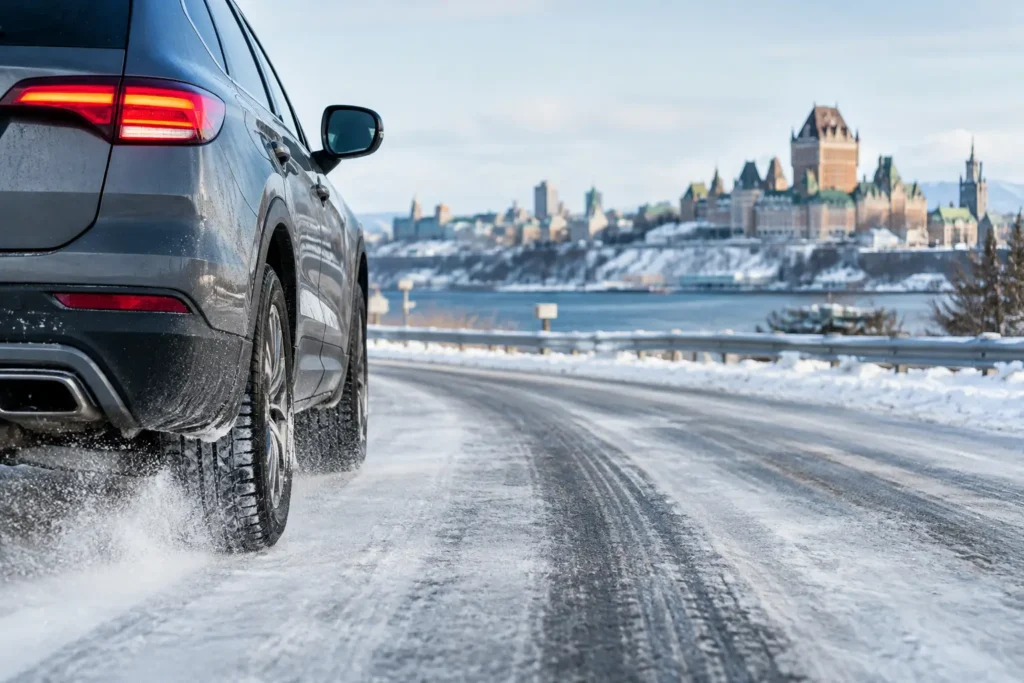
Quebec weather can turn a familiar route into a difficult driving environment quickly. Rain reduces tire grip and can create standing water. Snow can cover lane markings and hide icy patches. Black ice may look like ordinary pavement, particularly on bridges, shaded streets, and highway ramps.
In low-traction conditions, brake as early as possible and avoid abrupt inputs when you can. If a true emergency occurs, apply the brakes firmly and let ABS work if your vehicle has it. However, understand the trade-off: even correct braking technique cannot guarantee a short stopping distance on ice.
Winter tires in good condition, properly inflated tires, clear windows, and a vehicle cleared of snow all support safer stops. They are not replacements for space and reduced speed. A driver who leaves room has more options than a driver who relies only on quick reflexes.
Common Mistakes New Drivers Make
One common mistake is hesitating because the driver is afraid of braking too hard. In a genuine emergency, delayed braking can be more dangerous than a firm stop. Practicing controlled stops with a qualified instructor helps you learn the difference between assertive braking and panic.
Another mistake is gripping the wheel too tightly and making a sharp steering correction. Sudden steering can cause the vehicle to lose stability, especially on slippery pavement. Brake firmly in a straight line whenever possible, keep your hands positioned for control, and steer only as much as the situation requires.
Some drivers also look down at the pedals or mirrors during the stop. Your attention belongs on the road ahead. The more familiar you are with your seating position and pedal placement, the less likely you are to search for the brake when seconds matter.
Finally, avoid assuming driver-assistance features will prevent every crash. Automatic emergency braking, collision warnings, and other technologies can be helpful, but their performance depends on the vehicle, speed, weather, visibility, and the type of hazard. You remain responsible for watching the road and controlling your vehicle.
Practice Builds Calm, Not Recklessness
Emergency braking should be practiced only in a safe, legal setting with proper guidance. It is not something to test in a busy parking lot, on a public street, or near other people and vehicles. A professional driving instructor can choose an appropriate location, explain what you will feel through the brake pedal, and help you correct habits before they become automatic.
During driving lessons, controlled practice can help you become comfortable applying firm brake pressure, keeping your vehicle straight, and understanding how traction affects stopping distance. This is especially valuable for beginners, newcomers who are adapting to Quebec driving conditions, and drivers preparing for the SAAQ road test.
At Ecole Unity, practical instruction is designed to help learners build real-world judgment, not simply memorize maneuvers. The goal is to recognize risks early, make safe decisions, and drive with steady confidence when traffic becomes unpredictable.
The next time you sit behind the wheel, give yourself one simple advantage: create space. Space ahead, attention on the road, and practiced control of the brake pedal can turn a frightening moment into a safer stop.