

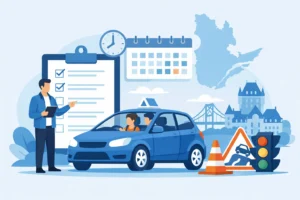
If you are asking how many driving lessons are required in Quebec, the short answer is clear: for a first Class 5 license, Quebec requires a complete driving course with 24 hours of theory and 15 hours of practical driving. That is the legal minimum for most new drivers following the standard licensing path. But for many learners, especially beginners and newcomers, the better question is whether the minimum will be enough to feel safe, prepared, and confident on test day.
Quebec’s licensing system is structured for a reason. It is designed to give new drivers time to build knowledge, good habits, and real on-road judgment before they earn full driving privileges. If you are starting from zero, that structure can be reassuring. You do not have to guess what comes next.
How many driving lessons are required in Quebec by law?
For most first-time drivers in Quebec, the mandatory driving program includes 39 total hours of instruction. That breaks down into 24 hours of classroom or theory training and 15 hours of in-car practical lessons with a certified driving school.
Those practical hours are not optional if you are getting your first passenger vehicle license through the usual route. They are part of the recognized driver education program approved by the SAAQ. In other words, if you are a new driver, you cannot simply practice with a friend and skip the formal lessons.
The practical portion is usually divided into multiple sessions rather than completed all at once. That pacing matters. Driving is not something most people absorb in a single weekend. Spacing the lessons out gives you time to practice, reflect, and improve between sessions.
What the required Quebec driving course actually includes
The required course is not just about learning how to turn, park, and merge. It combines theory and practical training in phases so students can build skills gradually.
The 24 hours of theory cover topics such as road signs, right-of-way rules, hazard awareness, sharing the road, alcohol and drug laws, speed management, and defensive driving. For teenagers and adults alike, this part lays the foundation for the knowledge test and for safer long-term driving habits.
The 15 hours of practical training focus on applying those rules in real traffic situations. Students typically work on basic vehicle control, lane positioning, intersections, parking, observation habits, and decision-making in different road environments. As lessons progress, instructors usually introduce more complex situations, including busier urban driving, changing lanes, and handling pressure calmly.
That progression is especially helpful in Montreal and nearby areas, where learners often need to deal with dense traffic, pedestrians, cyclists, construction zones, and winter conditions. A structured course helps make those challenges feel manageable instead of overwhelming.
Is 15 hours of in-car training enough?
Legally, 15 hours is the minimum practical training requirement. In real life, whether it is enough depends on the student.
Some learners come in with strong coordination, calm focus, and regular supervised practice outside their formal lessons. They may complete the required training and feel ready for the road test on schedule. Others need more repetition before driving feels natural. That is not a failure. It is a normal part of learning a skill that carries real responsibility.
A nervous beginner, an adult learning later in life, or a newcomer adjusting to Quebec road rules may benefit from extra lessons beyond the mandatory course. The same goes for students who have a long gap between lessons, limited access to practice vehicles, or difficulty with specific skills like parallel parking, lane changes, or busy intersections.
The goal should not be to finish with the fewest lessons possible. The goal is to become a safe, independent driver who can make good decisions without panic. Sometimes that takes only the required number of lessons. Sometimes it takes a few more, and that extra time can make a big difference.
Who must take the mandatory course?
The required course generally applies to first-time drivers seeking a Class 5 license in Quebec. This includes many teenagers starting the graduated licensing process and adults who have never held a license before.
If you are an immigrant or newcomer, your situation may be different depending on your previous driving experience and whether your license can be exchanged. Some drivers can transfer their license under specific agreements. Others may need to pass knowledge and road tests, and in some cases complete formal training. Because the rules can vary, it is worth confirming exactly where you fit before you register or book a test.
For newcomers, this is often where a supportive driving school adds real value. It is not only about lessons in the car. It is about understanding Quebec’s process, knowing what documents are needed, and avoiding delays or confusion.
How the timing works in Quebec
One reason people ask how many driving lessons are required in Quebec is that they want to know how quickly they can get licensed. The answer is tied not just to lesson count, but to the province’s graduated system.
New drivers must complete the recognized course in stages. After the initial phase, eligible students can take the knowledge test to obtain a learner’s license. They then continue through additional phases of theory and practical training over time. There is also a mandatory waiting period before the road test for a probationary license.
This means even if you are motivated and available every week, the process still follows a timeline set by regulation. That can feel slow, especially for adults who need a license for work or family responsibilities, but the staged approach exists to build experience gradually.
The good news is that a clear course structure can make the process feel much less stressful. When each phase is mapped out, you always know what you are working toward.
What extra lessons are usually for
Extra lessons are often the smartest choice when a student is close to test time but not yet fully comfortable. They can also help after a failed road test, when the issue is not a lack of effort but a few recurring mistakes that need focused correction.
In many cases, additional training is less about learning brand-new skills and more about consistency. A student may know what to do, but still hesitate under pressure. A few targeted sessions can improve scanning, speed control, parking accuracy, or lane discipline enough to make driving feel more automatic.
For learners who already have some experience, advanced or refresher lessons can also be useful. This is common with adults who drove in another country but need help adapting to local laws, signs, school zones, and exam expectations in Quebec. Knowing how to drive and knowing how to pass the SAAQ road test are related, but they are not exactly the same thing.
How to tell if you are ready for the road test
A lot of students measure readiness by one question: Can I complete the required lessons? A better question is: Can I drive safely without constant coaching?
You are usually getting close when you can maintain good observation habits, handle intersections without freezing, change lanes smoothly, follow signs and speed limits consistently, and correct small errors without losing focus. You should also be able to drive in ordinary traffic with steady control rather than relying on your instructor to talk you through every step.
If parking still falls apart every time, if left turns feel rushed, or if traffic makes you panic, more practice may save you time and money in the long run. Retaking a road test is often more frustrating than scheduling one or two additional lessons beforehand.
Choosing lessons with confidence
Not every student needs the same pace, and that is exactly why structured, student-centered instruction matters. A teenager may need reassurance and repetition. An adult beginner may want a practical explanation of every step. A newcomer may need help connecting previous driving experience to Quebec’s rules and testing standards.
The best learning environment is one that gives you both formal compliance and personal support. That means certified instruction, a clear course path, honest feedback, and room to build confidence at a realistic pace. At Ecole Unity, that approach matters because passing the test is only part of the journey. The bigger win is feeling calm, capable, and safe every time you get behind the wheel.
If you are just starting, remember this: Quebec sets the minimum, but your confidence decides what comes next. A few well-timed lessons can do more than help you pass a test – they can help you drive toward a safer, smarter future.