

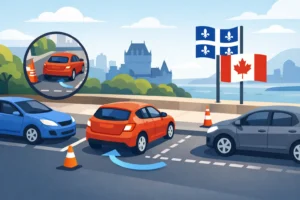
A lot of road test stress in Quebec comes down to one moment – pulling up beside a car, shifting into reverse, and knowing the examiner is watching every move. If you are searching for parallel parking test tips Quebec learners can actually use, the good news is that this part of the exam is very learnable. It is less about luck and more about setup, control, observation, and staying calm under pressure.
Many students think parallel parking is a trick maneuver. It is not. In most cases, learners lose points because they rush the setup, forget their observations, or overcorrect halfway through. Once you understand what the examiner wants to see, the move becomes much more predictable.
What the examiner looks for during parallel parking
On the Quebec road test, the examiner is not expecting perfection worthy of a driving video. They are looking for safe, controlled driving. That means proper observation before and during the maneuver, smooth steering, good speed control, and a final position that is reasonably close to the curb without touching it.
You are also being evaluated on judgment. Did you check around the vehicle before reversing? Did you signal? Did you keep the car slow and under control? Did you avoid rolling too far from the curb or bumping it with the tires? A slightly imperfect park can still pass if the maneuver is safe and well managed.
That is an important point for nervous drivers. The goal is not to impress the examiner. The goal is to show that you can park responsibly in a real Quebec street situation.
Parallel parking test tips Quebec students should practice first
Before you worry about tiny steering details, focus on the basics that make the maneuver easier. The biggest one is starting position. If your car is not lined up properly beside the vehicle in front, the rest of the maneuver becomes harder than it needs to be.
Pull up beside the parked car with about two to three feet of space between your vehicle and theirs. Your rear bumpers should be roughly aligned. If you stop too far ahead or too far back, your turning angle changes and you will usually end up too close to the curb or too far into the street.
The second basic is speed. Parallel parking should happen at a crawl. If the car moves too quickly in reverse, you lose time to steer and correct. Keep your foot controlled on the brake and let the vehicle move slowly. Test-day nerves often make people rush. Slower is better here.
The third basic is vision. Do not stare at one mirror and hope for the best. Use your mirrors, check over your shoulder, and stay aware of the curb, the parked vehicle, and traffic around you. Examiners notice observation habits just as much as the final position.
A simple step-by-step method that works
A consistent routine helps because it gives you something to follow when nerves show up. There are different methods, and your instructor may teach a slightly different version, but this general sequence works well for many Quebec learners.
Start by signaling and stopping beside the car ahead of the space. Check traffic, mirrors, and blind spots. Shift into reverse and look where the vehicle is going, not just at the dashboard or backup camera. If your test vehicle has a camera, do not depend on it as your only reference.
Begin backing up slowly. Turn the wheel toward the curb once your car reaches the right reference point based on your training vehicle. Continue reversing at low speed until the rear of your car enters the space at an angle. Then straighten the wheel briefly as the car moves farther in. After that, turn the wheel the opposite way to bring the front of the car into the space.
Once the vehicle is in, straighten the wheels and adjust if needed. You want to finish reasonably parallel to the curb, not touching it, and not sticking out too far. If a small correction is necessary, make it calmly. A careful adjustment is much better than forcing a bad final position.
The most common mistakes on test day
The first common mistake is starting too far from the parked car. That wide setup pushes your vehicle away from the curb and leaves you badly positioned at the end. The opposite problem also happens – getting so close to the other car that you feel boxed in before you even start.
Another mistake is forgetting observations once reverse begins. Some students do a good check at the start and then become fully focused on steering. The examiner wants to see ongoing awareness. Keep scanning and be ready to stop if a pedestrian or vehicle enters the area.
Hitting the curb is another frequent issue, but so is fear of the curb. Many learners overcompensate and finish much too far away. A clean result usually means close enough to look practical, but not so close that the tire makes contact.
There is also the panic correction. This happens when the car starts going off line and the driver makes a large, fast steering input. The maneuver gets worse, the student gets more nervous, and the whole thing snowballs. Small corrections work better.
How to stay calm when the examiner asks for the maneuver
Nerves can make even well-prepared students forget what they practiced. The best way to handle that is to reduce the situation to a routine. When you hear the instruction, do not think, I have to nail this perfectly. Think, Signal. Position. Observe. Reverse slowly.
It also helps to accept that the maneuver may not look exactly like it did in practice. Street spacing, curb shape, and vehicle size can vary. What matters is using the same safe process. If you need one adjustment, that is not automatically a problem. What matters is staying in control.
Take your time before moving. A one-second pause to check mirrors and breathe is better than rushing into reverse. Confidence on a road test often looks very quiet. It is not fast. It is not dramatic. It is steady.
Practice matters, but the right practice matters more
Doing ten rushed attempts in an empty lot is less useful than doing four careful ones with feedback. Parallel parking improves fastest when you repeat the same method in the same type of vehicle and learn your reference points clearly.
If you are practicing in Montreal or nearby areas, try to work on real curbside spaces rather than only cones. Real streets teach you how to judge distance, watch for traffic, and deal with pressure. At the same time, start in calm areas before moving to busier roads. Too much difficulty too early can hurt confidence.
This is especially true for newcomers and first-time drivers who are still adjusting to Quebec road rules. Parallel parking is not only a steering exercise. It combines control, awareness, and local driving habits. Support from a professional instructor can shorten the learning curve because they help you spot small errors before they become habits. At Ecole Unity, that confidence-building approach is exactly what helps many learners improve faster.
Vehicle differences can change the feel
One thing students often underestimate is how much the car itself affects the maneuver. A compact sedan, a hatchback, and an SUV do not turn or feel exactly the same. Window size, mirror position, turning radius, and seat height all change your visual references.
That means advice from a friend may not transfer perfectly to your test vehicle. If possible, practice in the same car or a very similar one. If you are renting a vehicle for the SAAQ road test, spend time getting comfortable with its mirrors, brake sensitivity, and steering response beforehand.
It depends on the car, and that is normal. The method stays similar, but the timing of your steering may need slight adjustment.
What to do if the first attempt is not perfect
Do not give up mentally in the middle of the test. Many students think one awkward angle means automatic failure, and then they unravel. Usually, the better move is to stop, assess, and make a calm correction if there is room and it is safe.
The examiner is watching your decision-making. A careful reset shows judgment. A rushed attempt to force the car into place often creates the bigger mistake. If you remain composed, use proper checks, and fix the position safely, you may still do fine.
That mindset matters beyond one maneuver. Road tests reward steady drivers, not dramatic ones.
Final thoughts for test day
Parallel parking gets easier when you stop treating it like a mystery and start treating it like a repeatable routine. Practice your setup, keep the car slow, check your surroundings, and let yourself make small corrections instead of chasing a perfect first move.
On test day, trust the process you practiced. Safe, calm, and controlled will take you much farther than trying to be flawless.