

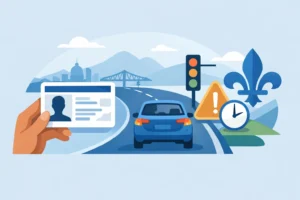
Getting your probationary licence feels like real progress because it is. You are past the learner stage, you can drive on your own, and daily life gets easier fast. But this probationary licence rules guide matters because Quebec still places important limits on new drivers during this period, and breaking them can lead to fines, demerit points, suspensions, or delays in reaching a full licence.
For many new drivers, the hard part is not turning the wheel or parking straight. It is understanding what the probationary stage actually allows, what it restricts, and how those rules affect school, work, family rides, and weekend plans. If you are a teenager starting out, an adult getting licensed later, or a newcomer adjusting to Quebec rules, knowing the details can save you stress and help you build safe habits from day one.
What a probationary licence means in Quebec
A probationary licence is the stage between a learner’s permit and a full Class 5 driver’s licence. It gives you much more freedom than a learner’s permit because you can drive without a supervising driver beside you. That is a big step, but it does not mean the rules become relaxed. Quebec treats this as a transition period where drivers are still expected to prove they can drive responsibly in real conditions.
The purpose is simple. New drivers face more risk because experience takes time. A probationary period helps reduce that risk by setting tighter legal limits while you develop judgment, awareness, and consistency behind the wheel.
In practice, that means you need to think beyond basic car control. Your legal responsibilities now include how many passengers you carry, whether you have any alcohol in your system, how many demerit points you can accumulate, and whether you are using your phone or taking other unnecessary risks.
Probationary licence rules guide: the restrictions that matter most
The most important rule for probationary drivers in Quebec is the zero-alcohol requirement. If you hold a probationary licence, your blood alcohol level must be zero when driving. Not low. Not under a small limit. Zero. That rule also reflects how Quebec expects new drivers to approach safety in general. If there is uncertainty, the safest choice is the right one.
Demerit points are another major issue. A full licence holder can accumulate more points before facing suspension, but probationary drivers have a much smaller margin for error. If you receive too many demerit points, you can lose your driving privileges much faster than you expect. That often surprises new drivers because one speeding ticket, one phone-related offense, or a few smaller mistakes can add up quickly.
Passenger restrictions also matter, especially for younger drivers. Depending on your age and how long you have held the probationary licence, limits may apply to the number of passengers age 19 or under you can carry during late-night hours. These rules are designed to reduce distraction and risky group driving situations. If you are the friend with the car, this can feel inconvenient, but the legal risk falls on you, not your passengers.
Mobile phone use is another area where new drivers get into trouble. Handheld phone use while driving is prohibited, and even when a driver feels confident, distraction can affect reaction time, lane control, and hazard awareness. For a probationary driver with a low demerit point threshold, one poor choice can have bigger consequences than expected.
Seat belt compliance is non-negotiable too. The driver is responsible not just for personal seat belt use, but often for making sure passengers follow the law as required. If you are driving siblings, friends, or classmates, that responsibility stays with you.
How long the probationary period lasts
For most drivers in Quebec, the probationary licence period lasts 24 months. That timeline can vary in certain situations, but the general idea is that you must complete this stage successfully before receiving your full licence.
This is where patience matters. Some drivers treat the probationary stage as a waiting room and assume they just need to avoid one major mistake. A better mindset is to use these two years to build strong habits that will stay with you long after the restrictions are gone. Smooth braking, mirror checks, speed control, scanning intersections, winter awareness, and calm decision-making all matter more than simply getting through the clock.
Common mistakes new drivers make
Many problems begin with a misunderstanding rather than intentional risk-taking. A driver may assume that because they can drive alone, they are now treated the same as any fully licensed driver. That is not the case. The probationary stage gives independence, but not full driving privileges.
Another common mistake is underestimating demerit points. New drivers often focus only on fines, but the point total can be the more serious consequence. Losing the right to drive can disrupt work, school, family responsibilities, and the licensing timeline itself.
Late-night driving with friends is another area where judgment can slip. Even when a trip seems short and familiar, the combination of fatigue, conversation, music, and peer pressure can create exactly the kind of distraction these rules are meant to prevent.
There is also a practical mistake that has nothing to do with road behavior. Some drivers stop learning once they pass the road test. In reality, the first year of solo driving is when many of the most important lessons happen. Continued practice in parking, merging, highway driving, and bad weather makes a real difference.
How to stay compliant without feeling overwhelmed
The easiest way to manage probationary licence rules is to simplify your choices before you start the car. If you are going out at night, know whether passenger limits could apply. If there is any chance alcohol is involved, do not drive. If your phone might distract you, put it away before the trip begins.
It also helps to treat every drive as part of your training, not just transportation. That sounds basic, but it changes how you pay attention. You begin noticing school zones, speed transitions, blind spots, cyclist behavior, and common Montreal traffic patterns more consistently. Confidence grows faster when it is based on awareness instead of guesswork.
If you are a newcomer to Quebec, take extra time to compare what you learned elsewhere with local expectations. Driving habits that seemed normal in another country or province may not fit Quebec enforcement standards, signage, winter conditions, or testing culture. That adjustment period is normal, and getting proper instruction can shorten it considerably.
Why professional training still helps after you get the licence
A probationary licence proves you met the standard on test day. It does not mean every real-world driving situation now feels easy. Many drivers still need support with highways, dense city traffic, parallel parking, left turns at busy intersections, and winter road confidence.
That is why continued lessons can be a smart choice even after licensing. A good instructor can identify habits you may not notice on your own, such as incomplete stops, rushed lane changes, poor scanning, or uncertainty in complex intersections. Fixing those early is easier than unlearning them later.
For students who want a clear, supportive path, a school like Ecole Unity can help connect the rules to real driving situations instead of leaving you to figure everything out alone. That kind of guidance is especially valuable for beginners and newcomers who want to stay safe while moving steadily toward a full licence.
A practical mindset for your probationary years
The best way to think about this stage is not as a punishment or a technicality. It is a protected learning period. You already have enough freedom to build real independence, but the rules are there to reduce avoidable mistakes while your experience catches up with your confidence.
Some days driving will feel easy. Other days, traffic, weather, or pressure from other people may make it harder. That is normal. The goal is not perfect driving every second. The goal is consistent, safe decision-making over time.
If you remember the core ideas in this probationary licence rules guide, you will be in a much stronger position: zero alcohol, very careful attention to demerit points, respect for passenger limits, no distracted driving, and steady habit-building every time you are on the road. Your full licence is not just about waiting out the calendar. It is something you earn through safe choices, one drive at a time.