

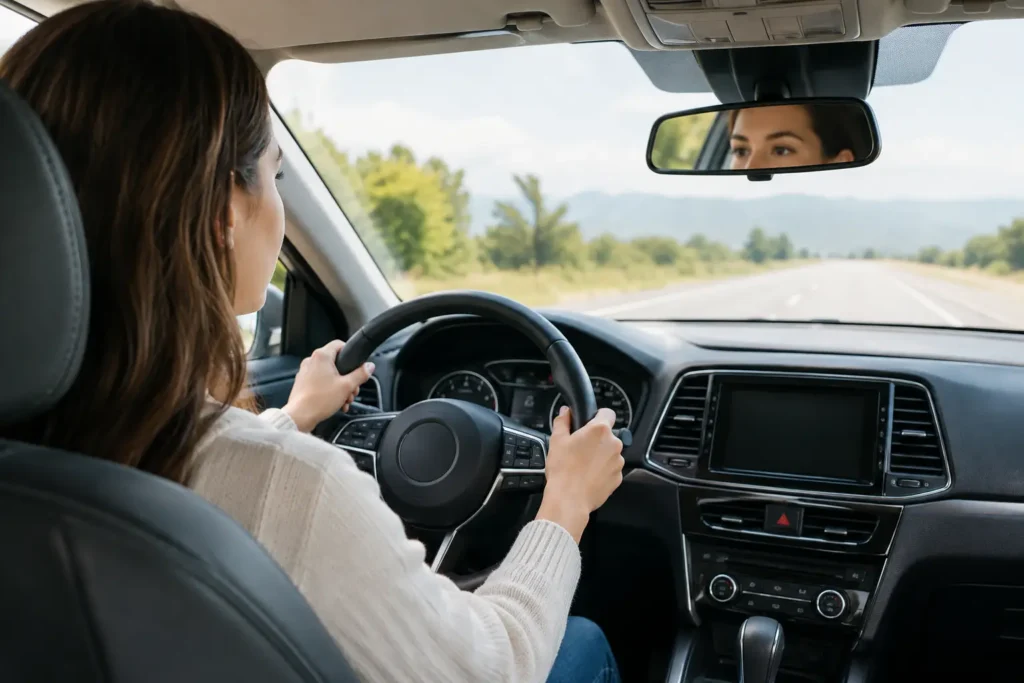
A beginner’s biggest risk is rarely a lack of effort. It is trying to process mirrors, signs, pedestrians, speed, steering, and other vehicles all at once. The road safety habits beginners build early turn those separate tasks into a steady routine. That routine creates the space to stay calm, make better decisions, and enjoy driving with more confidence.
For Quebec learners, safe habits also support success through every stage of the licensing process. Your instructor can teach the rules, but repetition between lessons helps those rules become actions you can perform without panic.
1. Set up the car before it moves
Safe driving begins before you put the vehicle in gear. Adjust your seat so you can fully press the brake and accelerator without stretching. Your back should be supported, your hands should reach the steering wheel comfortably, and your head restraint should sit near the middle of your head.
Then adjust the rearview and side mirrors. You should be able to check behind and beside your vehicle with a quick glance, not by twisting your body. Buckle your seat belt, make sure passengers do the same, and secure loose items that could slide under the pedals or distract you while driving.
This may feel slow at first, especially when someone is waiting behind you. Take the extra moment anyway. Starting in the right position gives you better control from the first second of the drive.
2. Look far ahead, not only at the car in front
New drivers often focus on the bumper directly ahead. That is understandable, but it limits the time available to react. Train your eyes to scan well ahead down the road, then return your attention to the space immediately in front of your vehicle.
Looking farther ahead helps you notice brake lights, changing traffic signals, a bus pulling over, a cyclist entering the lane, or traffic slowing near an intersection. When you see a situation early, you can ease off the accelerator and respond smoothly instead of braking sharply.
Your eyes should keep moving. Check the road ahead, mirrors, sidewalks, crosswalks, parked cars, and side streets. This is not about staring everywhere at once. It is a calm, repeated scan that helps you understand what could happen next.
3. Keep a real following distance
Following too closely is one of the easiest mistakes to make when traffic is moving quickly. Leave enough space to react if the vehicle ahead stops unexpectedly. In normal conditions, choose a fixed object ahead and make sure there is a gap of at least three seconds between the vehicle in front passing it and your vehicle reaching it.
Increase that distance when roads are wet, snowy, icy, dark, or crowded. You also need more space if you are tired, driving behind a large vehicle that blocks your view, or still learning how your car responds to braking.
A larger gap is not an invitation for stress. Other drivers may move into it, particularly in busy Montreal traffic. If that happens, calmly ease back and rebuild your following distance. Your goal is safety, not protecting a specific patch of pavement.
4. Make mirror checks part of every change
Before you brake, turn, change lanes, pull away from the curb, or enter traffic, check what is around you. Mirrors provide essential information, but they do not show every area beside your vehicle. That is why a shoulder check matters before changing lanes, merging, or moving away from a parked position.
Use a simple sequence: check mirrors, signal early, check your blind spot when needed, then move only when the space is clear. Signaling does not give you the right of way. It tells others what you intend to do.
This habit matters especially around bicycles, motorcycles, and pedestrians. A quick shoulder check can prevent a serious collision with a road user who is easy to miss in a mirror.
5. Slow down before the turn
Braking hard while turning can reduce control, particularly on wet or icy pavement. A safer pattern is to check your surroundings, signal, reduce speed before the turn, and then steer smoothly through it. Once the car is stable and the path is clear, gently accelerate out of the turn.
This habit is useful in every season, but Quebec winters make it essential. Snow, slush, black ice, and reduced visibility all increase stopping distance. The posted speed limit is not always the safest speed for current conditions. If visibility or traction is poor, driving below the limit may be the responsible choice.
6. Treat intersections as active spaces
Intersections demand more attention than most new drivers expect. Even with a green light, scan left, center, and right before proceeding. Watch for a vehicle that may enter late, a pedestrian stepping into a crosswalk, or a cyclist traveling beside traffic.
At a stop sign, make a complete stop behind the line or before the crosswalk. Pause long enough to assess the intersection, then proceed only when you know it is safe. Rolling through a stop sign may save a second, but it removes the time you need to see someone approaching.
When turning, remember that people walking and cycling can be harder to notice than vehicles. Do not focus only on the gap in traffic. Check the crosswalk and the space beside your vehicle before moving.
7. Put distractions out of reach
A phone notification can pull your attention away long enough to miss changing traffic or a person crossing the street. Set your navigation, music, and climate controls before you start moving. Put your phone away or use a permitted hands-free option only when it does not take your focus from driving.
Distraction is not limited to phones. Eating, searching for an item, managing a difficult conversation, or turning around to speak to a passenger can all affect your awareness. As a beginner, keep the car environment simple. Quiet practice drives often build confidence faster than drives filled with noise and pressure.
If something needs your attention, pull over safely and deal with it while parked. There is no message or missed turn worth splitting your focus on the road.
8. Drive predictably, not aggressively
Other road users cannot read your mind. Give clear signals, maintain a steady position in your lane, and avoid sudden braking or sharp changes in speed. Predictable driving makes it easier for everyone around you to respond safely.
You do not need to match another driver’s impatience. If someone follows too closely, cuts in front of you, or honks, avoid reacting emotionally. Keep your distance, stay focused on your route, and let the situation pass. Defensive driving is not about proving who is right. It is about giving yourself the best chance to avoid a crash.
9. Practice parking with observation first
Parking is not just a steering exercise. Before entering or leaving a parking space, observe the full area. Look for pedestrians, shopping carts, small children, open car doors, and vehicles moving behind you.
Reverse slowly enough that you can stop immediately if needed. Use your mirrors and turn your head to look in the direction you are traveling. Backup cameras can be helpful, but they are an aid, not a replacement for looking around the vehicle.
Parallel parking and backing into a space may feel uncomfortable at first. That is normal. Practice in low-pressure areas, use a consistent process, and do not rush because another driver is waiting. A careful reset is better than forcing a poor angle.
10. Review each drive without judging yourself
Progress comes from honest, specific reflection. After a lesson or practice drive, ask yourself what felt controlled, what felt rushed, and what you want to repeat next time. Maybe your lane changes improved, but you need more practice judging braking distance. That is useful information, not failure.
Keep your goals small and practical. One drive can focus on smooth stops. Another can focus on mirror checks and signaling. As these actions become automatic, you will have more attention available for complex traffic situations and SAAQ road test expectations.
Professional instruction can make this process clearer because an instructor notices patterns you may not see from the driver’s seat. At Ecole Unity, beginner-focused lessons are designed to build skills step by step, with guidance that supports both safe everyday driving and test readiness.
Confidence does not mean feeling fearless behind the wheel. It means knowing what to do next: check, assess, signal, slow down, and choose the safest option. Practice those habits on every drive, and the road will begin to feel less overwhelming and much more manageable.